0413 014 413
admin@valuefire.com.au
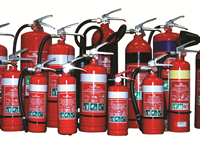
Fire Extinguishers Melbourne
Quality fire extinguishers for homes, offices, warehouses, and industrial facilities across Melbourne and Victoria.
The Right Fire Extinguisher for Every Environment
Not all fires are the same - and neither are fire extinguishers. Using the wrong type of extinguisher on a fire can be ineffective, or in some cases, dangerous. Selecting the correct extinguisher for your specific fire risks is one of the most important fire safety decisions a business or property owner can make.
Value Fire & Safety supplies a complete range of fire extinguishers for residential, commercial, and industrial applications across Melbourne and Victoria. Whether you need a single unit for a small office or a fully compliant supply and installation across multiple sites, our team can advise you on the right product for your premises, applicable Australian Standards, and ongoing servicing requirements.
Phone: 0413 014 413
Types of Fire Extinguishers We Supply
Dry Chemical (ABE) Extinguishers
Suitable fire classes: A (solids), B (flammable liquids), E (electrical equipment)
 The dry chemical ABE powder extinguisher is the most widely used type in Australian workplaces and one of the most versatile options available. It is effective against fires involving paper, textiles, wood, plastics, rubber, petrol, oil, paints, LPG, CNG, and electrically charged equipment.
Key advantages: broad fire class coverage, widely applicable across commercial and industrial environments, effective on both liquid and solid fuel fires.
Important considerations: when discharged, a fine chemical powder is released that can cause damage to sensitive equipment including electronics and machinery. The location and environment should be considered before selecting this type. Proper placement and regular servicing are essential for effective performance.
Carbon Dioxide (CO₂) Extinguishers
Suitable fire classes: E (electrically energised equipment), B (flammable liquids)
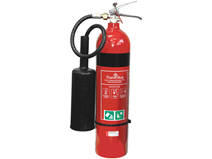 The CO₂ extinguisher is the preferred choice for electrical environments, server rooms, offices with significant electrical equipment, and areas where residue from other extinguisher types would cause damage. Carbon dioxide is extracted from the atmosphere, stored in liquid form under high pressure, and displaces oxygen to suppress the fire without leaving any residue.
Key advantages: leaves no residue, safe for use on electrical equipment, ideal for enclosed environments with high-value assets.
Important considerations: CO₂ effectiveness can be reduced in environments with significant air movement. Discharge in a confined space is not recommended due to oxygen displacement. Regular inspection and hydrostatic testing are required to maintain the pressure integrity of the cylinder.
Foam Extinguishers
Suitable fire classes: A (solids), B (flammable and combustible liquids)
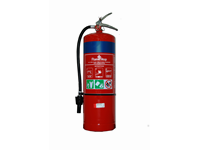 The foam extinguisher contains a concentrate mixed with water, producing a foam blanket when discharged that smothers the fire and prevents re-ignition. Available in a 9-litre capacity, it is well suited to environments where flammable liquid fires are a risk alongside standard combustible materials such as paper, wood, textiles, plastics, and rubber.
Key advantages: effective on both Class A and Class B fires, foam blanket prevents re-ignition, suitable for fuel and liquid storage environments.
Important considerations: must never be used on fires involving live electrical equipment or in any electrical environment. Regular servicing ensures the concentrate remains at the correct concentration level.
Air Water Extinguishers
Suitable fire classes: A (solids - wood, paper, plastics, textiles, rubber, rubbish)
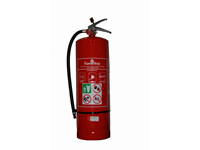 The air water extinguisher works by reducing the temperature of the burning fuel below its ignition point, bringing the fire under control. Available in the standard 9-litre capacity, it is one of the most straightforward extinguisher types and is commonly used in offices, schools, and residential settings where Class A fire risks are the primary concern.
Key advantages: simple and effective for Class A fires, widely available, easy to operate.
Important considerations: not suitable for Class B (flammable liquids), Class E (electrical equipment), or Class F (cooking oils and fats) fires. Incorrect use on these fire types can spread the fire or cause injury.
Wet Chemical Extinguishers
Suitable fire classes: F (cooking oils and fats), A (solids)
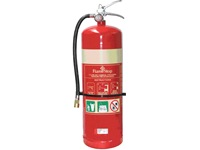 The wet chemical extinguisher is specifically designed for kitchen and hospitality environments where cooking oil and fat fires present a primary risk. Using saponification agents, it rapidly suppresses the fire and prevents re-ignition by forming a thick protective layer over the burning oil or fat surface. It is also effective on Class A fires involving wood and paper. Available in 2.0-litre and 7.0-litre capacities.
Key advantages: the only extinguisher type recommended for Class F fires, fast suppression, prevents re-ignition, suitable for commercial kitchen environments.
Important considerations: regular servicing and seal inspection are required to ensure the agent remains at full effectiveness.
Choosing the Right Extinguisher for Your Premises
Different environments carry different fire risks. Here is a general guide to selecting the right extinguisher type by application:
- Offices - CO₂ extinguishers are preferred where electrical equipment is prominent; ABE dry chemical units provide broad coverage for general office environments
- Commercial buildings - a combination of ABE and CO₂ units is typically recommended to cover electrical and general fire risks
- Warehouses and factories - ABE dry chemical extinguishers are well suited to large open spaces with mixed fuel types and machinery
- Retail stores - ABE and CO₂ units depending on the nature of stock and electrical equipment present
- Kitchens and hospitality venues - wet chemical extinguishers are mandatory for commercial cooking environments; additional ABE or foam units may be required for other areas
- Industrial facilities - site-specific risk assessment is recommended; specialist extinguisher types may be required depending on the materials and processes involved
Our team can carry out a site assessment to recommend the correct extinguisher types, quantities, and placement positions for your specific premises.
Fire Extinguisher Maintenance & Compliance
Supplying the right extinguisher is only the first step. Under Australian Standard AS 1851, fire extinguishers in commercial and industrial premises must be inspected and maintained at regular intervals to remain compliant and fit for purpose.
Key compliance requirements include:
- Six-monthly inspections to check pressure, condition, signage, and accessibility
- Annual maintenance covering a more thorough assessment of all components and discharge mechanisms
- Hydrostatic pressure testing at prescribed intervals depending on extinguisher type
- Service tagging after each inspection, with records maintained for audit and insurance purposes
Allowing fire extinguisher maintenance to lapse is not only a compliance risk - it means your equipment may fail at the moment you need it most. Value Fire & Safety provides professional fire extinguisher servicing across Melbourne and Victoria to keep your equipment compliant and ready.
Why Choose Value Fire & Safety
Over 10 Years of Industry Experience
Value Fire & Safety is a family-owned business with more than a decade of hands-on experience in fire safety equipment supply and maintenance across Victoria.
Quality Products from Trusted Manufacturers
We source our fire extinguishers from reliable, quality-conscious manufacturers, ensuring every product we supply meets Australian Standards.
Melbourne-Wide Supply and Service
We supply and service clients across Melbourne and Victoria, including Frankston, Dandenong, Springvale, Carrum Downs, and surrounding suburbs.
Compliance Expertise
Our team understands the regulatory requirements for fire safety equipment in Victorian workplaces and can help you select, place, and maintain compliant equipment with confidence.
Ongoing Maintenance Support
We do not just sell you a product and move on. Our team provides scheduled servicing, retesting, and compliance documentation to keep your equipment current year after year.
Supply and Servicing of Fire Extinguishers Across Melbourne
Whether you need to purchase new fire extinguishers, replace expired units, or set up an ongoing maintenance program, Value Fire & Safety is your local fire safety partner across Melbourne and Victoria.
Phone: 0413 014 413 Email: admin@valuefire.com.au
Frequently Asked Questions
Which fire extinguisher do I need?
The right extinguisher depends on the fire risks present in your environment. As a general guide: CO₂ for electrical equipment, wet chemical for commercial kitchens, ABE dry chemical for general commercial and industrial use, and foam or water for environments with solid combustible materials and no electrical risk. Contact our team for specific advice or request a site assessment.
How often should fire extinguishers be serviced?
Under AS 1851, commercial fire extinguishers must be inspected every six months and undergo a more comprehensive maintenance service annually. Additional pressure testing is required at longer intervals depending on the extinguisher type. Our servicing team can set up a scheduled maintenance program to keep you compliant.
What is a CO₂ extinguisher used for?
CO₂ extinguishers are designed for use on Class E fires involving electrically energised equipment, and Class B fires involving flammable liquids. They are the preferred choice for server rooms, offices with significant IT equipment, and any environment where residue from other extinguisher types could cause secondary damage.
Are fire extinguishers required by law?
Yes. The Building Code of Australia and the Occupational Health and Safety Act require appropriate fire safety equipment to be provided and maintained in commercial, industrial, and public buildings. The specific requirements vary by building type, occupancy, and risk classification. Value Fire & Safety can advise on the requirements applicable to your premises.